
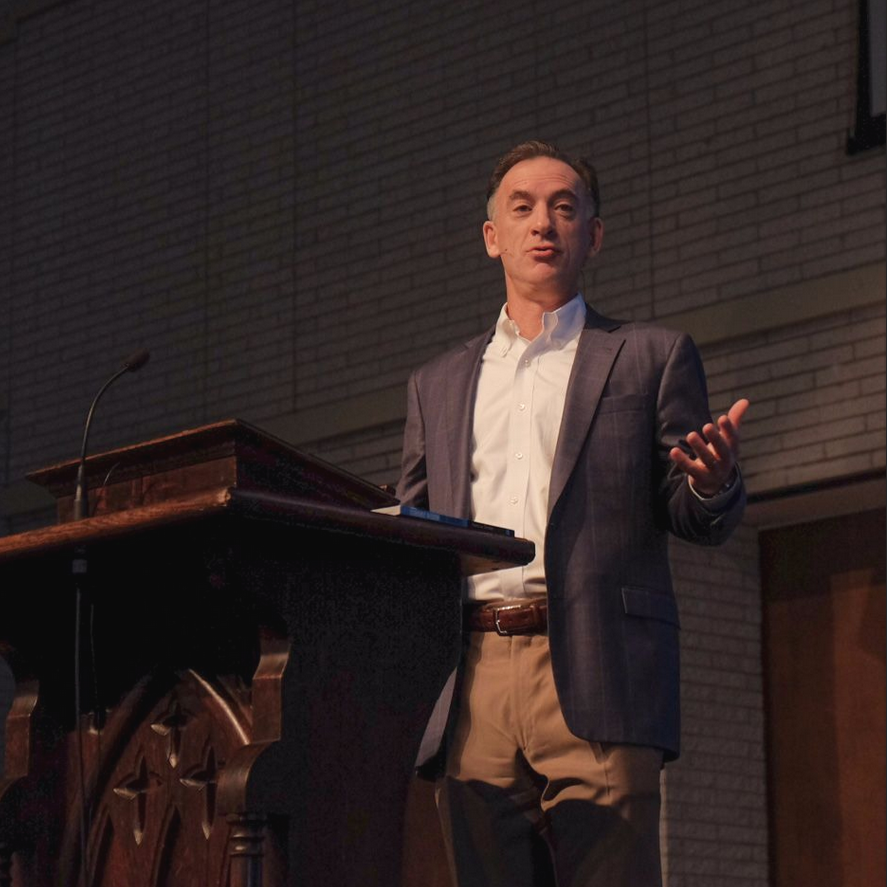
Finding Purpose and Value in Our Work with
Dan Doriani
Dan Doriani
Can work be meaningful even if it’s mundane? How do I know what work I’m called to do? Is work something that we have to do because of the fall of humanity? Jim Spiegel and Professor Dan Dorani discuss tough questions about finding meaning in your work. They both share stories of how they found their calling and encourage all of us to think about our work through the lens of serving others and making the world better.
Join us!
RESOURCES
+Working with Dan Doriani Podcast
+Dr. Daniel M. Doriani Bio from Covenant Theological Seminary
CONNECT
+Local to Columbus, OH? Register here for an upcoming class.
Kalos Center for Christian Education and Spiritual Formation | Jim Spiegel | Our Columbus, OH Events
Email us! podcast@kalos.center
Professor of Biblical and Systematic Theology at Covenant Seminary
Dan Doriani is a professor of Biblical and Systematic Theology at Covenant Seminary. He earned an M.A. at Yale University and an M.Div. and Ph.D. at Westminster Seminary. Dan has pastored several churches and has served in administrative roles at Covenant Seminary in addition to his work there as a teacher and scholar.
Since 2022, Dan has served on the Executive Board of The Gospel Coalition. Dan is a popular speaker at conferences and other venues and has authored or co-authored 20 books, which include biblical commentaries, works on gender roles, and books that explore a biblical view of work, which is what we'll discuss today. Dan has two excellent treatments of this topic, one entitled Its Purpose, Dignity and Transformation and another entitled Work that Makes a Difference, both with PNR Press.
In conjunction with these publications, Dan launched the Center for Faith and Work in St. Louis. He hosts the podcast Working with Dan Doriani, which features interviews with people whose work has been especially impactful.
“But the Bible says that those to whom much is given, much is required. And we have to take that with utmost seriousness. If you have had formal training, innate gifts, and mentors, you've probably acquired substantial skills.
And if you have those, by God's grace, you are not only called upon as a good steward to use those gifts, but you're actually called to account."
-
Dan Doriani [00:00:00]:
It's hard to be a lead pastor. I was a lead pastor. It's hard. You know, somebody just yesterday said to me a pastoral figure was just criticized right before the worship service started. He said, is this the way it goes? He was young. Is this normal that two people walk up to me right before my sermon and criticize the way I'm leading the church? I said, it's kind of normal. Yeah, it's pretty close to normal. I mean, within a three minute time frame, somebody's probably going to tell you something that made them unhappy because there you are.
Dan Doriani [00:00:33]:
And how about this? If you're a surgeon, if you're working on tiny little spaces in the spinal column or behind somebody's eye or in their nose, you know, back in the sinuses, and you nick a nerve, you hurt them permanently and it's nerve wracking. Wouldn't it be easier just to be a pediatrician and write prescriptions? Or not? For kids who have a cold, it would be so much easier.
Jim Spiegel [00:00:58]:
Welcome to the Kalos Center Podcast. Welcome to another episode of the Kalos Center Podcast. Our guest today is Dan Doriani. Dan is professor of Biblical and Systematic Theology at Covenant Seminary. He earned an M.A. at Yale University and an M. Div. And Ph.D.
Jim Spiegel [00:01:24]:
at Westminster Seminary. Dan has pastored several churches and has served in administrative roles at Covenant Seminary in addition to his work there as a teacher and scholar. And since 2022, Dan has served on the Executive Board of the Gospel Coalition. Dan is a popular speaker at conferences and other venues and has authored or Co authored 20 books which include biblical commentaries, works on gender roles, and books that explore a biblical view of work, which is what we'll discuss today. Dan has two excellent treatments of this topic, one entitled Its Purpose, Dignity and Transformation and another entitled Work that Makes a Difference, both with PNR Press. In conjunction with these publications, Dan launched the center for Faith and work in St. Louis. He hosts the podcast Working with Dan Doriani, which features interviews with people who whose work has been especially impactful.
Jim Spiegel [00:02:21]:
You can find a link to that podcast on our episode summary. So, Dan Doriani, welcome to the Kalos Center Podcast.
Dan Doriani [00:02:29]:
Well, it's good to be here, Jim. Nice to chat with you again.
Jim Spiegel [00:02:33]:
It's my pleasure to work with you today by talking about the work you do on work.
Dan Doriani [00:02:40]:
Yeah, working on work. Right. I like it.
Jim Spiegel [00:02:44]:
So I suppose the the most logical place to begin would be with a definition. How would you define work? Or how should we all understand work in terms of how it's defined and.
Dan Doriani [00:02:57]:
What is its origin yeah, so a good definition, not mine, is work is concentrated effort that includes a willingness to overcome obstacles, to accomplish something of significance. Now, what that is intended to do is distinguish from play, where you don't really care, you know, what happens when you're squirting each other with guns. And it also intends to differentiate between the subcategory of employment or a job and work. So we want to make sure we understand that someone who's taking care of children hour by hour, not just five minutes, but taking care of them for years and long periods of time is working. That cooking for health is work, for good meals is work, whether it happens in a restaurant or at home, washing dishes and making beds and so forth, which you could get paid for or not. It's work either way, when you overcome obstacles. It also covers people who volunteer at anything in a sustained and weighty concentrated manner. Key issue is you overcome obstacles.
Dan Doriani [00:04:05]:
If you quit the minute an obstacle comes up, you're not really working. You're just fooling around with something or dabbling in something. And the origin, of course, is what you and I agree, Jim, is that God ordained work for humanity from the beginning. That comes from the fact that God is a worker and presents himself as a worker, gives himself. You've seen the list, but I just jotted one down a minute ago. In the Bible, he calls himself a king. That's a job, teacher, shepherd, architect, judge, prophet, also a job, carpenter, warrior, creator, farmer, designer, potter, priest. Those are just a few of them.
Dan Doriani [00:04:46]:
So God's a worker, and therefore he wants us to work because he made us in his image.
Jim Spiegel [00:04:52]:
Interesting that the concept of overcoming obstacles is central to that definition of work when we so often associate obstacles with the Fall and the kind of a resistance that is ubiquitous in all of human experience in a fallen world. But God ordained work for human beings before the fall. So what's the significance of that?
Dan Doriani [00:05:17]:
Yeah, well, first of all, thanks for pointing out. We agree that work is not simply curse, right? It's not something to be avoided as much as possible foisted on machines or animals or slaves in ages past. In fact, there's still slaves, of course, all over the world today, in the millions, sadly. But work did exist before the curse, and I think it did include obstacles. I mean, if you look at what God put in the world, things like silicon. Silicon does not become a semiconductor by snapping our fingers. And there's no reason to believe there would not have been toil in developing technology, for example, or putting up buildings of size or creating instruments for Rapid transit. There's no reason to believe that's a result of the fall.
Dan Doriani [00:06:03]:
Right. Big world, people start connecting, people might want to travel. That would take work. And there wouldn't be people dropping things on their fingers and smashing their hands and getting injured and getting angry at each other. But I certainly think foresight, labor, extraction of minerals and making them formable and then formed to create what we want to use to promote human flourishing. In other words, we're not anti technology, we're not anti cultural development.
Jim Spiegel [00:06:35]:
So is the key difference there between work prior to and post fall the whole working by the sweat of your brow business?
Dan Doriani [00:06:45]:
Yeah, sweat of the brow. It's interesting. You know, we don't really know. Would it have been 72 degrees and balmy at all points forever and ever on Earth, or, you know, we have enjoyed. There's a good chance we would have enjoyed a little heat. We might have perspired a bit, but it wouldn't have been miserable sweat. You know, there's good sweat and bad sweat, and there's this sweat that comes because, you know you're failing. Flop sweats, we call them.
Dan Doriani [00:07:09]:
And there wouldn't have been flop sweatshirts, I don't think, without the fall. But there might have been some good perspiration. Right. I mean, it's good to run hard. When we run hard, we perspire. So sweat of your brow, I think we shouldn't just take literally, but we should take in the metaphorical sense. It's miserable sweat, I think, is what we're supposed to understand from Genesis, chapter three.
Jim Spiegel [00:07:35]:
And there is that concept that the apostle Paul mentions. Or it's a statement he makes about the world in its present form being in bondage to decay.
Dan Doriani [00:07:48]:
Yeah.
Jim Spiegel [00:07:49]:
Which it would be. Tell me what we think of this. I mean, it's very easy to associate that with this principle of second law of thermodynamics, which says that entropy increases. Right. That. That any closed system tends towards disorder. I wonder if that's part of the curse. And there are different views on that.
Dan Doriani [00:08:09]:
Yeah. I don't. Of course, I'm not a physicist, nor am I a theoretical physicist. So all I can say is it's a great question. I do recall a conversation with perhaps one of the most thoughtful architects I've ever known, who said, I'm going to ask God when I meet him why he made water so that it causes wood to decay. Because so many problems as an architect come from the decay of wood through moisture. Why did he make the world that way?
Jim Spiegel [00:08:39]:
I don't know.
Dan Doriani [00:08:40]:
And was it always that way? So these are hypotheticals.
Jim Spiegel [00:08:43]:
Right.
Dan Doriani [00:08:45]:
So I'm going to leave it at that. I'm going to confess my ignorance.
Jim Spiegel [00:08:48]:
Yeah, water, Water, like fire. It's our best friend and our worst enemy.
Dan Doriani [00:08:52]:
Right? Yeah, right, Right.
Jim Spiegel [00:08:54]:
So some people say that all work, or at least all morally legitimate work, is equal. Do you think there's any truth to that idea? That it's all equal in value? If that isn't right, then why is it problematic?
Dan Doriani [00:09:08]:
Yeah. So first of all, a few people thank you for your careful formulation of the question. You and I agree that all work is not equal. There's work that's destructive. And for example, if you're promoting addictive video games for three year olds, that's not good work. It's legal. We want to distinguish between what's legal and what's moral. Obviously, anything that's addictive, anything that's destructive is illegitimate.
Dan Doriani [00:09:32]:
So is all morally legitimate, as God defines moral, legitimate, equal? And the answer is yes in some ways and no in some ways. So in some ways, yes. Because if someone digs a ditch or shovel snow, which I was just doing 20 minutes ago, that's good work. I mean, there's nothing wrong with shoveling snow or raking leaves. And if I have snow on my driveway or my sidewalk, and if I have leaves in my yard that are choking out some plants that I like, then I should remove them. The question is, can God be pleased with that? Well, certainly if my attitude is good. I'm doing it to please my wife, please my neighbors, beautify my property, or take care of my property so nobody falls. That's all good.
Dan Doriani [00:10:19]:
The person who washes dishes, scrubs floors, scrubs pots, all those people are doing good work. Especially of course, as they do it honestly and they work hard and they do it unto the Lord. It's all equal. But it's also true that work is unequal because some work has more strategic heft or significance than other work. And I'll say that's obvious. I mean, the person who's scrubbing floors at a major corporation has far less ability to promote the good that that corporation seeks than the CEO or other people in the corporate executive suite. So they can please God equally, but one person has more leverage to do good in the world in that sense. I don't know if, let's just say better, but it's of greater value to the world at large.
Dan Doriani [00:11:05]:
And then, of course, if you hone your skills and maybe I'm not just shoveling Snow. But I'm the best snow shoveler around and I'm teaching other people how to shovel snow really well so that streets are safe. Then that's worth a little bit more than somebody who's reckless or heedless about the way they shovel snow or do anything else. But then the real question is, what do you do gifts you don't really like having, or you're able to do some things that are very arduous. So Jim, you pointed out, I've been a pastor about 16 years or more. 16 years in large churches and then about 5 years in small churches. Besides being a prophet. And it's hard to be a lead pastor.
Dan Doriani [00:11:43]:
I was a lead pastor. It's hard. You know, somebody just yesterday said to me, cause they were criticized, a pastoral figure was just criticized right before the worship service started. He said, is this the way it goes? He was young. Is this normal that two people walk up to me right before my sermon and criticize the way I'm leading the church? I said, it's kind of normal. Yeah, it's pretty close to normal. I mean, within a three minute time frame, somebody's probably going to tell you something that made them unhappy because there you are. And wouldn't it be easier to be, I don't know, a truck driver? People don't go around criticizing truck drivers right before they get in the truck.
Dan Doriani [00:12:25]:
And how about this? If you're a surgeon, you know, if you're working on tiny little spaces in the spinal column or behind somebody's eye or in their nose, you know, back in the sinuses, and you nick a nerve, you hurt them permanently and it's nerve wracking. Wouldn't it be easier just to be a pediatrician and write prescriptions or not for kids who have a cold, it would be so much easier. But the Bible says that those to whom much is given, much is required. And we have to take that with utmost seriousness. If you have had training, if you have innate gifts plus training, formal training, plus mentors, informal training, plus friends, more informal training, you've probably acquired substantial skills. And if you have those, by God's grace, you are not only called upon as a good steward to use those gifts, but you're actually called to account. One of my favorite passages on this is Luke, chapter 12, verse 20 and 48 both say this, but 1248 is what I was quoting. To whom much is given, much will be required.
Dan Doriani [00:13:34]:
But then 1220 talks about that rich farmer. You know him, and at the end of his life he stored up all this wealth and it at the end God says, whose will they be? And the answer is not yours, but you'll be called to an account. I'm just going to quote the verse in the ESV for a second, but God said to him, fool, this very night your life will be required of you. Now that word, required means called to account. What did you do with what I gave you? You just heaped it up for yourself. You're going to have to give an account for that. I gave you much and you spent it selfishly. Then Jesus says later on, so learned a lesson.
Dan Doriani [00:14:14]:
If you've been given much, used much, and we do please more. It's a long answer. We please more when we make the most use of the gifts, opportunities, skills training, mentoring that we've received. So in that sense, all work is not equal. I'll say it just one different way. I loved unloading trucks when I was 20, 21 years old. My first job after college, unloaded trucks for a few months. Loved it.
Dan Doriani [00:14:37]:
Simple, clean start. Three hours later, truck's empty, everything's put away. Great. Sometimes they're really long for that. But I think it would be a sin for me to unload trucks once I got my PhD, no matter how much easier it would have been.
Jim Spiegel [00:14:56]:
It's interesting how every line of work has its own unique stresses. Some like that the stresses are more physical, sometimes they're more psychological, sometimes they're more relational. And depending on how public the work is, maybe the stresses have to do with the criticism and how your public platform really, if it doesn't invite the criticism in any case, it certainly occasions more of it. You've probably known as I have some coaches at D1 schools who are very high profile and what might have appeared to be a kind of, whoa, cushy multimillion dollar job where you're doing nothing but, you know, you know, helping young people play this game you love. You know, what could be more fun than that? Then you realize, whoa, not so fast. That is not a job I want. And I think maybe they're earning their multimillion a year paycheck.
Dan Doriani [00:15:58]:
At least they deserve to be paid. Well, that's. I'm not sure. I love the idea that, you know, the best elementary school teacher in the world gets as much in 10 years as they get in 10 days. More or less.
Jim Spiegel [00:16:11]:
Yeah.
Dan Doriani [00:16:12]:
Or at least the high end athletes, but they work very hard and they have high skills and they bear a heavy burden, no doubt.
Jim Spiegel [00:16:17]:
Yeah. The counter to what I just kind of casually mentioned Is, you know, they deserve it, is that. Well, let's look at the intrinsic value of what is being provided to society by, let's say an NBA basketball player. You have someone, and this is different than being a coach where you, if you're, if you're a good coach at whatever level, you're doing character formation. But let's just talk about the players and the superstars in, say, NBA basketball. What are they doing? They are repeatedly putting a, a rubber sphere through a metal ring. I mean, that is literally what they're doing. And they may be getting paid 10, $20 million a year to repeatedly put a rubber ball through a sphere.
Jim Spiegel [00:17:02]:
And if they're good defensively, they stop other people from putting rubber balls through their ring. And so compare the intrinsic value of that to, say, a first grade teacher. My first grade teacher, Mrs. Rogers at Harlan elementary School in Birmingham, Michigan, she taught me to read. There's someone who taught you to read, Dan, and that's just your life. Think how transformed our lives have been. And then you multiply that out. Say somebody teaches first graders for 30 years, they're teaching thousands of kids to read.
Jim Spiegel [00:17:37]:
And how that ramifies out in their life in terms of their service to society, that there's no comparison. And yet they're making tens of thousands a year rather than millions. One could argue that's inherently unjust.
Dan Doriani [00:17:49]:
Yeah, well, you're saying you don't like.
Jim Spiegel [00:17:51]:
The market system, and then that's the problem. Is there a better system than capitalism? And that's a whole other debate.
Dan Doriani [00:17:57]:
So let me just have fun with this for a second. Of course, I believe that teaching is extremely valuable and should be valued. The question of the marketplace, I mean, you know, even, I don't know, not all that, but 30 years ago, a million dollar salary was extraordinarily high, and now 40 million is almost routine in certain sports. How can this happen? Of course, the answer is what they're actually doing is not simply putting a ball through a sphere, it's putting a ball through a sphere, despite very talented people trying to prevent them from doing that. With hours and hours and hours of training at evading those who would try to prevent them from putting it in the sphere in order to sell products, in order to market products. That's what they're really doing. They're putting on something that's construed as entertaining whether you like it or not. It's construed that way by a lot of people.
Dan Doriani [00:18:52]:
Like driving a car in a circle is considered endlessly entertaining to some people and endlessly boring to other people. But if enough people think it's entertaining, then advertisements and then you get to present your product and offer it to the world. So it's actually part of the marketing system. They're advertisers, they're entertainers, and they are selling advertising space.
Jim Spiegel [00:19:16]:
And the fact that so often once they retire, once they've reached the ripe old age of 38 years old, then many of them go into full time endorsements. Think about the Manning brothers. You mean that is their career now they're endorsing every product under the sun.
Dan Doriani [00:19:33]:
It is one in a thousand. I've known any number of professional athletes. You've known coaches. I've known athletes and none of them are now. And one of them won a significant award and others are player of the week but had to retire after injuries after four years. Things like that. Nature. They're good players, they made it to some degree, but none of them are selling.
Dan Doriani [00:19:52]:
You got to hit big time. So they work hard. I don't want to trash them. Although it does make you laugh to consider who gets paid what in America.
Jim Spiegel [00:20:02]:
So do you see any significance in the distinction between work that serves to address or undo the consequences of sin, like medicine, counseling, auto repair, physical therapy, and then lines of work which don't do that necessarily, like art, music, as we've been talking about, athletics, construction, where you could, you can imagine or maybe expect that that kind of work will continue into the eschaton even when everything's fully redeemed and there is no sin. Do you see any significance to that distinction?
Dan Doriani [00:20:34]:
I think it's a very interesting one. And when I teach about it, I certainly spend a little bit of time with students or with listeners saying there's basically two kinds of work. There's restorative work and intrinsically valuable work. The distinction isn't quite as hard as we might ask. You posed the question about the second law of thermodynamics. Would auto repair have occurred without the fall? Maybe. I mean, would tires have lasted forever? If they would last forever, wouldn't that mean there was no friction? Don't we need friction to walk as well as run and drive a car? I mean, friction's the way we get around the world. The way anybody moves anywhere requires friction.
Dan Doriani [00:21:15]:
So, you know, auto repair might have been around. Regardless, I certainly don't want to say that work that's merely restorative is bad or deficient. I mean, Jesus was above all restorative. Right. So, I mean, he was a carpenter. Yes, but he was the one who came to give his life as a ransom for many because many were enslaved and so to sin and death. And therefore he was doing reparative, restorative healing work. And we're glad of it.
Dan Doriani [00:21:45]:
There is a certain degree of pleasure, I would say, in doing work that is manifestly meeting basic human needs like food, clothing, shelter, childcare, teaching. I think teaching would have occurred. There'd be teachers of music and the arts and geography. Who knows what we would have had. Maybe physics as well. Medical care, you know, is certainly restorative. Boy, I'm sure disinterested in devaluing medical care or counseling care. So it's interesting, but not all that important.
Dan Doriani [00:22:23]:
Yeah, in my view.
Jim Spiegel [00:22:24]:
Yeah, no, I. I think I share that. That intuition and it certainly motivates deep thinking about the eschaton and the redemption of all things and. And could be useful in response to somebody who maybe looks down on the arts. Say someone who's really strong, strongly sort of stem oriented in their. In their disposition, and they, ah, you know, you artists or music people. Yeah, I guess there's a place for it. But it's not as important as what we do as scientists just to have a ready retort.
Jim Spiegel [00:22:58]:
Well, but as a sir, even as a surgeon, you know, well, what will you do in the next world?
Dan Doriani [00:23:04]:
Right.
Jim Spiegel [00:23:05]:
That we know there will be. I am quite confident there will be artists and there will be plenty of music, maybe more than we can imagine, and maybe it'll take more prominent place for all we know. So there. We know there. There will be adjustments in terms of our value system. Who knows, Maybe that's one of them.
Dan Doriani [00:23:22]:
Yeah. There may be preachers in the eschaton, but there won't be evangelists.
Jim Spiegel [00:23:27]:
That's right.
Dan Doriani [00:23:28]:
I love to ask students sometimes, hey, what jobs will disappear. And of course, surgeon, oncologist, things like that disappear. Prison guard. Yep. Criminal defense attorneys. Prosecutors, no, but there could be lawyers. I mean, you might need laws when you have lots and lots of people near to regulate behavior. Nobody would fight about it.
Dan Doriani [00:23:48]:
How about police? How about policemen? In the new creation, I say there could be a few, like traffic cops, you know, they could. They do a good service to help people get in and out of a big event safely.
Jim Spiegel [00:23:59]:
But how about this? And we all long for this. No more locks or passwords.
Dan Doriani [00:24:05]:
Yeah, that's for sure. I love that one. Yeah. No, it. Theft prevention, folks. But hey, you know what? Let's give a shout out for the armed services in peaceable countries, because in a world of Military predation, strong armed forces prevent people from attacking peaceful people. Right. So it's a negative to a positive end.
Dan Doriani [00:24:32]:
And a lot of the work that's a consequence of the fall is of that character. It preserves something, prevents evil, thwarts evil, cuts back on evil, which certainly doesn't mean it's evil or unimportant in itself. Right.
Jim Spiegel [00:24:48]:
So what do you say to the person who feels a sense of vanity in their work? And say that for all the labor that they're doing, they're not accomplishing much or that their work, though providing a genuine service is not really that important in the long run and they feel depressed by that.
Dan Doriani [00:25:07]:
Yeah. So if you're depressed, the first thing I want to say to anybody who's out there who's depressed is get outside more, walk around with the sun shining, walk around in nature, look at the trees. That's the best cure for depression. One of the other good cures is having a job you think matters. So let's just say a couple things. First of all, you and I are both. Your very question implies that we agree that we're not just in favor of cheerleading. Your work matters.
Dan Doriani [00:25:34]:
Hooray. Hooray. Some work doesn't matter. And sometimes people think their work doesn't matter because it doesn't matter. They're advertising garbage and they know it's garbage. Or they're selling, I don't know, they're changing the colors on Skittles a little bit so they catch the eye of a child a little more. Or they're tweaking the recipe for artificial blueberry smell so that you can pump it out and people will buy more of your blueberry muffins, that might be worth a little something if the muffins are good. But some work is pretty low importance.
Dan Doriani [00:26:11]:
You know, selling cotton candy at the ball game, low. You might be frustrated by that. So my first word for somebody who thinks their work is meaningless would be this. Go ask a few people. If you're a Christian, ask your pastors and Christian friends if this work seems worthless or if it is worthless. So if you're marketing low cost beer, cheap beer that's basically created to help drunks get drunk, then your work is meaningless. And if a couple of people tell you that, get out of there, do something else. Market something you care about.
Dan Doriani [00:26:43]:
But sometimes we're wrong. And a signal event in my interest in work was a man who's just desperate about the meaninglessness of his work. So he thought driving a bread truck and I thought, I'D never heard the question. I was pretty young, but I was speaking at a conference and I thought, oh, my goodness, people need bread. I asked him quickly what kind of bread he made. It was a good bread, whole bread, you know, nutritious. And I said, you know, we agree people need bread to eat, right? Right. Yep.
Dan Doriani [00:27:19]:
Well, I mean, it's got to get to people's doorstep somehow. The way we do it in America is by distribution system. You're part of that. And I think that it helped them. He had to think it through. It's not like the light came on. He was joyful five minutes later. But I would say he was wrong, that his work is not meaningless.
Dan Doriani [00:27:36]:
Or the person who processes loans and they say, well, I just crunch numbers. Well, just crunching numbers. You still have to use some judgment and. And lots of ijust. Jobs actually have hidden value. You just don't see it because you're bored or it got repetitive. You have a bad boss. So ask first of all, is your work really meaningless? And if it is, get another job.
Dan Doriani [00:27:59]:
And if it isn't, then search out the question, how can I make it more meaningful, see its value, and use my agency, whatever amount I have of agency, to make the place a little bit better? I mean, car repair, you said earlier, you may say, that's all I'm doing is replacing brakes. Yeah, but brakes are important for cars. That's. You need them, makes everybody safe. Way to go.
Jim Spiegel [00:28:25]:
They're saving lives.
Dan Doriani [00:28:27]:
Right?
Jim Spiegel [00:28:27]:
Big stuff. Yeah. I. I think the first order of business we would agree on this is if anybody has any doubts, just reflect on the nature of your work. I mean, that would be sort of the. If there's one thing that people should be taking away from your podcast or mine is how should I think Christianly about what I do? And maybe that would prompt a move. And you say, yeah, this is not really serving people in a way that's significant. Maybe I should look for another line of work.
Jim Spiegel [00:28:57]:
I had a student who was a recent graduate at the time at university where I used to teach. And he called me one day, said, Dr. Spiegel, I want to run something by you regards a potential career choice. I said, okay, great. He's a very talented young man. His name is Chris. I say, well, okay, well, what's on your mind? He says, well, you didn't know this about me, but I'm an extremely good poker player.
Dan Doriani [00:29:25]:
I've had this conversation too.
Jim Spiegel [00:29:27]:
And he says, I have become aware of the fact that I could actually make a living at this point in different forums and with competitive poker. And he was recently married. I could support my wife and me and any kids we might have. What do you think of that as a career? And I just asked, I went Socratic on him, as I'm sure you do with a lot of these questions. I said, well, Chris, ask yourself this. Who am I serving by this work? And isn't the biblical ideal that we should be making the world a better place in the sense of serving, helping other people? How is my work helping other people? And I just know this, when I get to the other side, I want to stand before Jesus and, and, and know that I served other people for decades or as long as I was able, I helped other people or I did my best. Ask yourself, if you're just playing poker and making money that way, who are you helping? And I just posed that question to him. And in an email a few days later, maybe it was a few weeks later, he responded, he says, yeah, I'm going to be doing something else.
Jim Spiegel [00:30:39]:
And I said, hey, you probably poke around the side, you know, within, you know, legal and moral parameters, but you got profound gifts. I think he went on to grad school and I'm sure he's done very good, productive, you know, service oriented work. So you've had that conversation with others?
Dan Doriani [00:30:58]:
I've had the exact same conversation and more than once, unfortunately, and with mixed results. On one occasion, you know, I'm going to go promote the state lottery. And I said, you know, that's a disproportionate, that's a regressive tax on the poor who think they're going to hit it rich and oh, well, we're promoting education. I said, well, is it really helping? Is it net? So you say you're helping the poor. Are you would look into the question, who buys lottery tickets before you give yourself to this? That's one. And he did it for a number of years, despite my counsel. I wasn't his pastor. I was on a sports team with him.
Dan Doriani [00:31:37]:
And so I didn't have much authority. But another person said, yeah, I see it. All I'm really doing is taking money away from people. I'm not serving them, I'm exploiting their weaknesses. So we agree on that.
Jim Spiegel [00:31:50]:
What would you say, or what is your sense of the prevailing view of work in our country today?
Dan Doriani [00:31:56]:
Yeah, that's an important question. I'm going to be real quick with this. Okay, There are three views and then we can explore it if you want to. Number one, make as much as you can, as fast as you can, get some rare skill or do some work that most people don't like to do, and stop as early as you can. Retire at 50. That's one another. Work like a madman till you're 50 and then enjoy the next 30 years or whatever. Or a mad woman.
Dan Doriani [00:32:26]:
Number two is very common today among a certain age group, and that is I want a job that requires me to work 35 or 40 hours at the most. I want to earn enough. I do not want to work overtime. I do not want to want to even really work 40 hours a week if I can help. But I want to get a skill that gives me enough money that I can enjoy the weekends. I can go skiing or kayaking or hiking or ballooning or whatever it is I want to do. I live a relatively modest life. I don't need a big house.
Dan Doriani [00:32:56]:
I don't need a fancy car. I just don't want to work that hard. So somebody epitomized it this way. The person who is happier you is probably doing less than you. So don't work so hard. That's number two. The third one is, yeah, we know, we heard a hundred times that being an artist or a musician or pursuing your dreams is the way to poverty. I don't care.
Dan Doriani [00:33:22]:
I'm willing to pursue the path to poverty. I'm not giving up on the goal of self actualization, self realization, self expression. That's not a very big group right now. Used to be bigger than it is. So those are the big three. Among secular people, I think among Christians, we're still asking questions like, what did God give me the ability to do? Or what skill set did God give me that can be formed? So it's beneficial to my neighbors and possibly even in some way transformative, at least for my corner of the world. Not many people say I'm going to change the world, but a lot of people are still very positive about the idea of changing my neighborhood or changing my work team of five or 10 people. So that's profoundly commendable in my view.
Jim Spiegel [00:34:14]:
Yeah, I've run into those first two. Far more than that latter one, though, I think maybe there's a Christian version of that that I think that I held when I was a graduate student working in my PhD in philosophy. And I'd been told, look, there are three or four PhDs for every job you'll never get, you'll never get hired. And I just said, basically, darn the torpedoes, I. I am going to do this thing. And fiddlesticks.
Dan Doriani [00:34:42]:
On the torpedo?
Jim Spiegel [00:34:43]:
Heck, yeah. And then I, I said, even if I don't get a job, I'll in, in the academy, that is, I'll dig ditches, I'll collect trash. I want to learn about the history of ideas. I think I knew I was answering a kind of sense of a call to be a writer. And you're a writer, you know how that is. And I wanted to be involved in the great conversation. Right, because you can't be a great writer if you're not engaged in the big ideas. And so.
Jim Spiegel [00:35:14]:
But that kind of transcended employment for me. But God had this in mind and against all odds, he brought me, you know, these academic positions. And so, you know, notwithstanding that attitude, which I do think was a position of faith because I was, I was answering what or acting on what I did, sense was God's call on my life.
Dan Doriani [00:35:39]:
Yeah, well, and a lot, I think a lot of people do that, don't they? Certainly anybody gets a PhD in anything but the hard sciences or math, so forth is doing so as a matter of faith, knowing that you very well won't use your training in a directly remunerative way.
Jim Spiegel [00:36:02]:
So regarding calling, it is common to talk about a sense of calling in one's work. Maybe you would talk about how maybe you have a story of the sense of God's call in your life to do the work you've done in ministry and in the academy. What is a Christian or biblical view of calling? And then what can one do to be sensitive to that call of God on their life?
Dan Doriani [00:36:26]:
Yeah, thanks, that's a great question. So first of all, when the Bible speaks about calling, it predominantly speaks of a call to Christ, that is hearing the call to believe. Just look up the word call in the Bible or called the Christ called the holiness called to respond to God. That's by far number one in terms of the use of the word calling. The concept of calling is a little broader. And so we have people summoned by God to do things like deliver Moses, deliver the people from Egypt. The word call isn't there, but it's clearly his calling. David called to be a king, Joseph called to work for a pharaoh, to preserve many lives, etc.
Dan Doriani [00:37:09]:
Solomon called in measure to Paul, called to be an apostle to the Gentiles. So the word call isn't there very much. So we don't distinguish between word and concept. So the word and the concept are not together very much in the Bible, really. Only in 1 Corinthians, chapter 7. Remain in the position you were in when you were called, which implies that your position as Jew or Gentile, slave or free, is a part of your calling. And so then that teaches us that calling is not simply to a job, but it's also to a place and also to a group of people in that place. And locatedness is vital.
Dan Doriani [00:37:51]:
So at one point I was offered a job in another city. It was a very interesting job, leadership position. And I turned it down. And my wife. My wife and I were going for a walk and we. We stopped and turned and looked at each other simultaneously and said the exact same words. I think we're supposed to stay in St. Louis.
Dan Doriani [00:38:15]:
And that's. I think that's part of my call in life, is to be in St. Louis for whatever reason. I could give you all kinds of reasons. You don't want my life story right now, but. So call to a place counts then, with regard to your particular calling in life. I would say we have a rough sense of what we're supposed to do with ourselves based on what we're good at and what we like when we're young, maybe children or even. You sense it Sometimes when you're 10 or 15, you get a little better sense as time goes by.
Dan Doriani [00:38:45]:
But one of my favorite books by Mr. Epstein called Range explains, about seven years, six years old, now, explains how many people found their perfect spot by leaving their spot for a while and going to a cognate or adjacent field. And other skills that they had not perceived in themselves emerged. Or a person at work who's not quite sure they're in the right place. I always say volunteer if you're not sure in the right place, stay in your job, but volunteer to do something a little different. Don't ask to be relieved of a burden, just do something else. Say, hey boss, what else do you have for me? And a lot of people discover their true calling in life in this iterative process that goes on for the next 10 or 15 years after you finish college. Certainly, I'm going to guess you and I both found that we had skills that we didn't see in ourselves that emerged somewhere around the age of 35 or 40 or 43, because we just did stuff and people said, oh, you're good at this.
Dan Doriani [00:39:46]:
And you thought, am I? Oh, yeah, maybe I am. And then you end up doing it for 15 years.
Jim Spiegel [00:39:53]:
Yeah, that's sort of the happy side of the fact about human nature, that sometimes that person is the last to find out something significant about themselves. Right. Our wives, they know our vices long before we do. Right. But. But they also know our gift set, maybe at least aspects to it that we're not aware of. And that's the beauty of Christian community and family. And people will point things out to you and you say, wow, yeah, I guess I am good at that now.
Jim Spiegel [00:40:24]:
I see that now that I'm 40. Right?
Dan Doriani [00:40:26]:
Yeah. Well, I mean, I'm a grandfather now, and I'm pretty good with my grandkids. You know, I helped some of them. They kind of gravitate toward me sometimes when they're in a little bit of stress or feeling lonely. I mean, who would have thought that? But there it is. Another way to put it is all leaders are talent scouts. Right. And if the leader is a good person, good man, or good woman, seeking not only their own cause, but the good of the people who work for them, that is to say, they're not going to recruit people to a job that will crush them just to meet their needs.
Dan Doriani [00:40:59]:
Right. So a good talent scout, who knows, somebody is always looking at, assessing.
Jim Spiegel [00:41:06]:
This.
Dan Doriani [00:41:06]:
Young man, this young woman could be good at this. I'm going to give them a chance. Hey, I'm going to take a tiny break here. Close my door. I don't know if you can hear it, but my wife is a piano teacher.
Jim Spiegel [00:41:16]:
Oh, good. Yeah, I heard some hymns being played. No, it was some Christmas carols. So as I was looking to go into philosophy to get a PhD and to teach, I would sometimes mention that I sensed a call. And now in retrospect, it's even clearer to me. For a variety of reasons, God was calling me into this. Well, you probably know well that the guild philosophy, not exactly friendly to theism, much less Christianity. In fact, there's a certain hostility there.
Jim Spiegel [00:41:49]:
And where I did my PhD, there were certainly no Christians. I didn't find out there was a theist until the day I defended my dissertation. And this one of my readers, he was a longtime Marxist. And this is in the early 90s, and with the collapse of the Soviet bloc, there were a lot of Marxists, you know, felt kind of disillusioned. And he had announced to me, you know, as we were walking back to our cars, he said, yeah, I think at this point in my life, I'd call myself a theist. And I just wanted to hug him. You know, it's so rare. Turned out his wife had been running a Bible study in the neighborhood.
Jim Spiegel [00:42:24]:
She was an Evangelical Christian. I'm sure she'd been praying for him. He's a dear, dear guy. I mean, there were A lot of profs in that department that I just, I dearly love. They're just really sweet, kind folks, kind of in spite of themselves. They, they had these, these, these virtues, you know, that were very Judeo Christian, but still the overall and to this day, wow, there is a sense in which you're being thrown to the wolves. So some would be suspicious, skeptical about the idea being called into that field or to say certain fields in the business world or to particular organization, say, that prizes values that are antithetical to biblical values. Do you think it's possible to, notwithstanding all that, to get a call, to go into such environments? And how should one go about deciding whether to accept an offer to work in such a setting?
Dan Doriani [00:43:24]:
Yeah, important question. So there's no question at all in my opinion that it's right to head into settings where you are in a anti Christian or hostile environment. Now we see this in places in the Bible. Joseph worked for Pharaoh who was under delusions of grandeur. David worked for Saul who was self aggrandizing, violent, fitful. The biggest one, of course, is that Obadiah, not the prophet, but another Obadiah, worked for Ahab. And at the time that Elijah was calling down judgment, he was working for Ahab. They met, you know, in Kings, right? So he clearly was there.
Dan Doriani [00:44:07]:
We don't know was he converted while he was there? Was his father in that role? We don't know how he came to do that, but he was saving the lives of the prophets, whom Ahab and Jezebel certainly would have killed if they could have. So the question then becomes, can you do good in that spot? And now good is not just providing for your family, but you know, if you say Joseph saving lives in a famine, but rightly staying in that position, but Moses not staying because the Pharaoh he could have worked for was genocidal and he couldn't have supported that. Right? So it depends on whether you're able to do good or not. I'd like to point out that Elijah and Obadiah met each other. Neither one said the other was wrong. Obadiah didn't say Elijah, stop complaining and criticizing. Just get in on the inside and shape it, reshape it from the inside, be transformative within. He didn't say that.
Dan Doriani [00:44:55]:
Nor did Elijah say, Obadiah, what are you doing working for that murderer? They respected each other, right? So we have different callings. I wouldn't call him a friend, but I had a long conversation with a man who worked for Disney Corporation. He was high up. He directed the first Mulan movie, which made about a half a billion dollars about 20 years ago. And there were a fair number of Christians. But Disney at the time was unabashedly hostile to Christianity, and they had internal. He eventually left. He said, I can't use my creative powers.
Dan Doriani [00:45:26]:
I've got to leave and go independent. But his friend said, if you leave, you're one of the most powerful people here. If you leave, what's going to happen to the leaven that occurs? So people say, how can any Christian work in the military? Well, the answer is you can work in a good military that's trying to preserve peace. And I think we all would have been glad if some of the Christians who were working in Germany in the 40s had succeeded in getting rid of Hitler instead of coming close and failing and paying for it with their lives. So I certainly think we should ask the question, am I able to do good in this place? Restrain evil, present at least Christian morals, or remind people, if you're in the entertainment industry, hey, there are Christians watching. You know, if you're at Netflix, for example, which is, you know, really fond of creating programming that has blasphemy as a routine feature of dialogue, can you cut it down? Can you point out, hey, you know, we got 30 million Christian viewers, so why don't we cut down on the blasphemy? If, on the other hand, you're forced, we might say, to write scripts, and you keep hearing from the boss, we need more blasphemy, you probably have to leave. So I wouldn't say probably have to leave. You definitely have to leave or ask to work on children's programming or something.
Dan Doriani [00:46:45]:
So the question is, can I work in a setting hostile to God? Undoubtedly, the answer is yes, if you can restrain evil, bring some gospel light to the place. By which I do not simply mean sharing the faith evangelistically with the people next door to you. I mean, also the leavening influence of the gospel. And if you can't, then get out of there.
Jim Spiegel [00:47:08]:
Yeah, that's good. Well, switching gears a little bit, you know, complementing our business on earth, doing work, doing so much work, so much of the. The week is dedicated to that. There is rest and relaxation and recreation. What would you say is the proper place of recreation in the Christian life? And how does a person know when they've achieved a reasonable balance?
Dan Doriani [00:47:40]:
The reasonable balance is made very clear to us, fortunately, by Scripture. Six days you shall labor, and then a day of rest. Now, that doesn't mean you work all day every day. And it certainly doesn't mean you should be employed six days. You can be employed three days, four days, five days, six days, depending on the nature of your job. Because work is more than employment. So we need to have definite sustained periods of rest. That's very clear.
Dan Doriani [00:48:06]:
I think you and I probably both read quite a few biographies. And one of the things you notice if you look at highly productive people is that they go on sort of rampages of work and they just write whole books and. Hey, Heidegger, what was Hedegar's book he wrote in six weeks? I don't know.
Jim Spiegel [00:48:26]:
Being in Time.
Dan Doriani [00:48:26]:
Being in Time. I think he wrote it in six weeks. Of course, he had to fix it up. And then after that enormous push, they collapsed. And they call themselves lazy. You can't. We're not machines. Right.
Dan Doriani [00:48:40]:
So you need. You need rest. I don't know about you, but my story certainly is one where I'm very prone to work too hard and kind of assume that work is essential to get done. What needs to be done, I better do it, because nobody else is doing it. Work too hard. And so I try to make sure I take a walk outside every day of some length, and maybe I'll do it with one of my daughters, lives right up the street, or my wife. Or I may walk and talk on the phone, or I may walk and pray or think about a problem at some length. And I play tennis.
Dan Doriani [00:49:19]:
I played basketball for years and years, including on the courts of Geneva College for a number of years, both as an undergrad and then teaching for a while. Love the game of basketball and other sports. And I love to hang out with children, my children and then my grandchildren. And I partly spend a lot of time with them. So I'm not working all the time because I'm trying to fight my own propensity to be a workaholic in the tink. To exaggerate my importance in weaker moments. So a day of rest helps with that.
Jim Spiegel [00:49:51]:
It can take a lot of work to fight the impulse to constantly work.
Dan Doriani [00:49:57]:
A lot of effort. Yeah, that's right. A lot of effort.
Jim Spiegel [00:49:59]:
So you strike me as a shooting guard. Was that your position or.
Dan Doriani [00:50:04]:
I was one of those people could play any position. I've shrunk as I get older. I was 6:1, so in a pickup game, I could play point. I like point guard. Or I love to rebound. I really love rebounding. So if I'd been a little taller, I would have been a very happy forward.
Jim Spiegel [00:50:20]:
Huh? That. Yeah, rebounding. I tell you, there are times where tempted to call it a spiritual gift. I mean, it's just, it's that significant. It doesn't, it doesn't get the attention that, you know, a number of other basketball skills.
Dan Doriani [00:50:32]:
Hey, I, I love to watch a ball in the air and go, I know where it's going.
Jim Spiegel [00:50:36]:
Yeah.
Dan Doriani [00:50:36]:
And, and get an offensive rebound like, how did that ball land in his hands? Because I was watching the arc.
Jim Spiegel [00:50:42]:
Yeah. You might not be a studied physicist, but there's a kind of intuitive sense of physics there that involves, and all.
Dan Doriani [00:50:50]:
Sports involve instantaneous assessments of questions like where will this ball land? And how can I get in position to be where the ball is going to land?
Jim Spiegel [00:51:01]:
There's an essay how all athletes are intuitive physicists.
Dan Doriani [00:51:07]:
Well, if you watch an outfielder, professional outfielder, a ball game, and watch them go after a ball and the good ones land at the right spot, you know, when they're going full out, they get to the spot at the exact perfect instant, not a tenth of a second too early, not a tenth of a second too late. It's a marvel to behold.
Jim Spiegel [00:51:27]:
Yeah. Risking their health in the process.
Dan Doriani [00:51:29]:
That's true.
Jim Spiegel [00:51:30]:
For the sake of the team. Final question. We close all our interviews with this question which more or less relates to whatever the guest special competencies or expertise are. And I think it's especially apropos here, and that is question about the meaning of life. What is your view of the meaning of life and how has your professional work aimed to work that out, that conviction, to work out that conviction in practice?
Dan Doriani [00:52:02]:
I'm going to give you a disappointing answer. You ready? I don't really know. I don't know. I don't know. I can give you the right answer. The right answer is the purpose of life is to glorify God and enjoy him forever. I can guess at the meaning of life. The meaning of life is to know the Lord and to live faithfully for him in the body with the spouse, in my case my wife, my children, my grandchildren, my sons in law, my friends, my co workers.
Dan Doriani [00:52:41]:
To live life in a way that lets me enjoy them and love them and serve them according to the gifts and abilities and opportunities the Lord's laid in front of me. And I think there's a. I mean certainly I have less of my life ahead of me than behind me. And I look back and I think, how on earth did I get all these opportunities? How did I get these skills? What blessings have been poured on me? How can I make sure that I'm not just consuming them, but sharing them and if possible, multiplying them. Of course, I do that as a teacher above all, and a preacher and an evangelist. I'm not, you know, an overt evangelist, but it's funny. It's just funny to me. People walk up to me every once in a while and say, hey, I just want you to know that I trusted Jesus while you were preaching last month.
Dan Doriani [00:53:34]:
Just thought you'd like to know that. I go, great. What did I say? What happened? And it's often the most ordinary point imaginable that the Holy Spirit somehow used, but it hit them. That wasn't even the point of the sermon. That was just a setup for the main point. Well, for me, it was the main point. So just serve faithfully and see how God chooses to use it.
Jim Spiegel [00:54:03]:
So I haven't known you long, but already I can say there's several people who've told me you were one of their favorite professors or favorite teachers ever at Covenant, and in whatever other context they've. They've learned under you. So you're. You are impacting a lot of souls. And. And what? My life. I've boiled down my life mission to two words. I can sum up two words, and maybe you identify with this, and that is to fortify souls.
Jim Spiegel [00:54:33]:
Oh, I want everything I do, whether I'm a. Whether I'm a parent, teacher, friend, husband, whatever. Everything I do, I want it to serve that mission, to fortify souls. And that means it implies a certain balance. Right. None of us can write, who are writers, can write all the books or articles we'd like to. We need to scale back, make sure we're not compromising time with our wife, kids.
Dan Doriani [00:54:59]:
Right.
Jim Spiegel [00:54:59]:
And I believe that's one of the things that on Judgment Day, I'm not going to regret. Right. Is the. Is the time I've spent with the people I love and helping people and nurturing souls, fortifying souls. That. And. And being unqualified in my forgiveness. You know, there's actually a debate about this, whether.
Jim Spiegel [00:55:20]:
Whether we really should be totally categorical in forgiving. There's kind of a. I hope it's a minority report in the Christian theological world that. That says, well, no, you can withhold forgiveness until somebody apologizes. And. And that's not my view. I've prayed the Lord's Prayer too many times. I don't want God to be holding back forgiveness of certain sins that I've yet confessed.
Jim Spiegel [00:55:47]:
Right. But so I am all out with that and all out and all in with fortifying souls. So much so, so far as I can manage. And Sounds like that's your view as well.
Dan Doriani [00:56:00]:
I love that answer. I mean, I might even. I might have to change it a little so I can make it mine. But two words, you know, That's a fantastic answer. Can I just comment on forgiveness? I know, this is kind of awesome.
Jim Spiegel [00:56:10]:
Yeah, please.
Dan Doriani [00:56:11]:
I think it's helpful, you know, to distinguish between the two forms of forgiveness. There's the unconditional, absolute, Christlike forgiveness, which we certainly owe to everybody because we don't wish God's judgment or wish doom or endless pain or an inability on their part to repent. We wish the best for them. So we always forgive everyone from our heart. But I don't have the texts in front of me here, but, you know, there are places in the Bible you can appeal to that seem to indicate that you don't. You know, if they don't. There's a time when you do forgiven, the time when you don't, you don't. When somebody doesn't repent.
Dan Doriani [00:56:49]:
So if someone's sins are forgiven, if you forgive someone their sins, they're forgiven. So what that means is the absolute in the heart. I always forgive everybody. But transactionally, if someone, let's say I'm a pastor and someone seriously wrongs a child in my church, I don't let it go. I don't say, oh, let's just forgive them, meaning I'll let it go. We will not let this go until this person. I'm not talking about the legal side. If it's a crime that's been committed, let's.
Dan Doriani [00:57:20]:
Let's say it's not. They're just cruel to a child. We're not going to let this go until this person recognizes what they did. Because for their soul and the soul of the child, it's important to not simply say, oh, let's just forgive them. You don't understand that you crush this child and it's terribly wrong to do so. You need to not do that or you crush this woman or this man. We're not going to let it go. So there's the absolute sense, the Christ like redemptive sense, and there's the doing justice in this world sense, which we might call, say, has a transactional element.
Dan Doriani [00:57:54]:
I forgive you when you recognize you did wrong. That's probably why there's a disagreement, because there's a failure to make a distinction, you philosopher. We love making distinctions.
Jim Spiegel [00:58:02]:
Yeah, that is really good. And I was speaking of it the first sense.
Dan Doriani [00:58:05]:
Yeah.
Jim Spiegel [00:58:05]:
The second sense is clear from the Pauline literature and elsewhere. You know, he's pro X communication and one that can be a very gracious thing to do to someone that you have forgiven, but as an act of grace, now excommunicate. And then he says in one case he's delivered someone over to Satan to be taught not to blaspheme. Presumably there is that personal forgiveness but that discipline which the church has failed in many ways in our time to be serious about that, that kind of church discipline when it turns out to be a very gracious thing and is consistent with personal forgiveness.
Dan Doriani [00:58:42]:
Exactly.
Jim Spiegel [00:58:43]:
Well, thank you, Dan. This has been wonderful. I've enjoyed our conversation. I'm sure our listeners will benefit from this.
Dan Doriani [00:58:50]:
Well Jim, it's been a pleasure to get to know you a little better by having this conversation now. Thanks for your great questions and may the Lord bless this podcast.
Jim Spiegel [00:58:58]:
Thank you for listening to the Kalos Center Podcast to get notified when we publish a new episode. Please subscribe and let us know what you think by leaving us a review.