
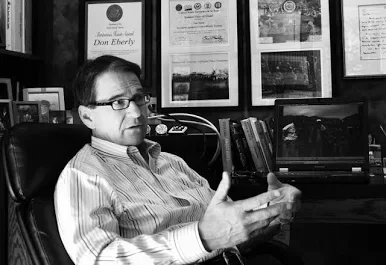
Don Eberly
Can America Rekindle its Civic Spirit?
Jim Spiegel sits down with Don Eberly to examine the crucial links between civic life, family structure, and the pursuit of the common good. Don Eberly draws from his experience in government, post-war reconstruction in Iraq and Afghanistan, and his work with the National Fatherhood Initiative to explore the foundations of social renewal.
They discuss the challenges of individualism, the crisis of fatherlessness, the urgent need for moral renewal in today's society, and much more. Join us!
RESOURCES
+Don Eberly Website
CONNECT
+Local to Columbus, OH? Register here for an upcoming class.
Kalos Center for Christian Education and Spiritual Formation | Jim Spiegel | Our Columbus, OH Events
Email us! podcast@kalos.center
“The Founding Fathers used the word virtue 6,000 times. And I am stunned by how the term virtue has disappeared in our society. Or it's dismissed as a politically-fraught kind of term that's aimed by its promoters at taking somebody's liberties away or silencing opposition."
Leadership in post-war reconstruction in Iraq and Afghanistan
Don Eberly has had an illustrious career of strategic leadership across corporate, nonprofit, and government domains. In the corporate realm, Don served in multiple executive positions with DynCorp, a major military contractor that provides services for U.S. national security and foreign policy objectives. As a nonprofit leader, Don's many initiatives include founding the National Fatherhood Initiative, now the largest civic organization committed to increasing the number of children raised by committed, engaged fathers.
Don's work in the public sector spans over two decades of service in Washington, where he held several key positions in Congress, the White House, the Defense Department, and the State Department. While serving as Deputy Assistant to President George W. Bush, Don was a major player in the Office of Faith-Based and Community Initiatives. His work also includes senior-level post-war reconstruction service in Iraq and Afghanistan, for which he received the prestigious Joint Military Civilian Commendation Award.
Don is the author of several critically acclaimed books, including Liberate and Fatal Flaws in the Early Strategy for Post-War Iraq, as well as America's Civil Society and the Renewal of American Culture. He also co-authored with Ryan Streeter The Soul of Civil Society: Voluntary Associations and the Public Value of Moral Habits.
-
Don Eberly [00:00:00]:
However shallow, an agreed upon set of principles for conducting our public life and public debate. You know, an agreed framework for actually respecting each other, for listening to each other. So Edmund Burke said manners are more important than law because to a large extent, the law depends upon manners. Why? Manners govern gently. They're not highly coercive, they're not heavy handed. They're not, they're not prescriptive. As in, like some people associate the assertion of religion in public life as prescriptive, as something that's, you know, is, is going to legislate its way to, to, to effectiveness. Manners govern softly.
Don Eberly [00:00:42]:
It's a certain amount of social approval or disapproval with it, but it's not the heavy hand of government. You can, you can accept it or ignore it if you choose to, but manners can take you a long way to toward actually avoiding the need to politicize everything. The need to legislate everything, the need to litigate everything is a soft form of regulating an open, free society.
Jim Spiegel [00:01:06]:
Welcome to the Kalos Center Podcast. Welcome to another episode of the Kalos Center Podcast. Our guest today is Don Eberly. Don has had an illustrious career of strategic leadership in corporate, nonprofit and government domains. In the corporate realm, Don served in multiple executive positions with DynCorp, a major military contractor that provides services for US national security and foreign policy objectives. As a nonprofit leader, Don's many initiatives include the National Fatherhood Initiative, which is now the largest civic organization committed to increasing the number of children raised by committed, engaged fathers. And Don's work in the public sector includes over two decades of service in Washington, where he held several key positions in Congress, the White House, the Defense Department, and the State Department. While serving as Deputy Assistant to President George W.
Jim Spiegel [00:02:08]:
Bush, Don was a major player in the Office of Faith Based and Community Initiatives. And Don's work also involves senior level post war reconstruction service in Iraq and Afghanistan. It was for this work that he won the prestigious Joint Military Civilian Commendation Award. Don is the author of several critically acclaimed books including Liberate and Fatal Flaws in the Early Strategy for Post War Iraq, Another volume entitled America's Civil Society and the Renewal of American Culture, a volume I just read, co authored with Ryan Streeter entitled the Soul of Civil Society, Voluntary Associations and the Public Value of Moral Habits. So, Don Eberly, welcome to the Calo Center Podcast.
Don Eberly [00:03:01]:
Thank you. Wonderful to join you.
Jim Spiegel [00:03:04]:
So your career has been incredibly wide ranging and I suppose we could talk for hours about each major chapter in your career. And today I mainly want to talk about some of the themes in Your Soul of Civil Society, which is a rich and wise book. But first I have to ask you about your major takeaways from your work in the Middle east under the Bush administration. I know listeners will be intrigued by that. As I understand it, you were one of the first American civilians in Iraq after the removal of Saddam Hussein, when what were some of the valuable lessons that you gained in your experiences there and in Afghanistan?
Don Eberly [00:03:47]:
Yeah, as you said, we could probably spend the entire hour just talking about any one of these topics, but on that particular topic we could spend probably the rest of the day. I think as we speak, there are probably 50 PhDs being worked on on the topic of Iraq. What happened, what went right, what went wrong. But the question actually is a helpful teeing up of the story of my work because it really covers the last 25 years of my life starting in the Bush White House. I was all domestic policy until 911 came along. And you know, we can talk about this later, but the Bush years and this interested in so called compassionate conservatism was one of the periods of revitalization of what we call civil society, which is this all embracing term that covers sort of non governmental, non political, non market institutions, typically local, typically volunteer based and which provide an enormous, enormously important set of values to our democratic society. So I was, yeah, the, probably the, the lead architect for the design of the faith based office and the staffing and then for the first hundred days we focused on the rollout of it. And interestingly enough, Bush to this day I think has a very big heart for these things.
Don Eberly [00:05:09]:
And he did. It's hard to imagine how it might have played out had 911 come along, which you know, recall it came along in his first year and it changed everything. In fact it was that occasion that caused six months later the chief of staff to say, Don, you know, I think your services are going to be needed internationally. And it was that pivot point literally that accounts for the last 20 years of my career actually being spent internationally and getting to Iraq. What they needed was some assistance in framing up post war social and governmental revitalization. I mean in America civil society mostly means, you know, as I say, voluntary associations, so called mediating institutions, citizen led internationally. It takes on stronger overtones of rule of law, constitution, pluralistic parties, and basically building institutions where they don't exist if your idea is to create democracy. So I was on the planning team for the first three months, months in the Pentagon, working on planning for post war and then launched to Kuwait City, then ultimately into Baghdad, where I was, yes, one of the first American civilians.
Don Eberly [00:06:22]:
And I served under the first two presidential envoys there. And obviously on our first arrival there, it was a very chaotic picture. It was very hard to picture how we were going to bring order, let alone a stable, flourishing democracy, which of course was part of the, part of the objective to replace a tyrannical dictatorship with something that was a little bit more geared to respecting the people and bringing them their voice into the government. So in the post war period there were a lot of things that came into focus very quickly. One was having to figure out how to bring about the continuity of government services because the prior regime had completely melted away. Its leader had been taken out and most of the senior officials had fled. And however, there was still a very, very strong base of Saddam loyalists in and around Baghdad and elsewhere where they had fled. And so the first issue I would say is, really has to be mentioned is that we did what we did in large part to avoid a reverse coup, in effect, that is for the bath party elements to come back and keep in mind that Saddam was still alive for a couple months after he was removed from power.
Don Eberly [00:07:43]:
To come back in an attempt to reestablish power that would have been like after the fall of Hitler, the Nazi party somehow managing its way back into a position of power. Not a small thing at all, but we've been criticized as a post war team for going too far to cut into the prior government. It was called De ba'. Athification. The Ba'ath party was the Nazi party equivalent in Baghdad. So we removed, yes, large elements. So the senior inner circle, security circle, military command, and of course the senior officials across the government, particularly those that were loyal to Saddam and unwilling to face a new future that we were there to create. So we cut pretty deeply and that all of this, however, was we, we struggled to get, find the right path because the order from Washington was to do it pretty quickly.
Don Eberly [00:08:41]:
In other words, title my book, liberate and leave, question mark. Well, what are you going to do if you're going to leave? You're basically handing a country over to chaos, which is what we had. We rushed elections and the elections were premature because the first thing that a fragmented country does that had no prior experience with democracy was to organize around existing factions, namely religious and ethnic. You had the Kurds in the north and you had Persians and you had Arabs and you had Sunni and you had Shia and so forth. So they turned to the mosque and they turned to religious leaders and ethnic leaders to participate in the elections, which shaped actually how democracy would evolve in that country. I think the biggest challenge initially was to simply try to give the Iraqi people this sense of emerging normalcy. So we did a lot to try to promote community based activities, including sports, which is a remarkable story all of its own, and to give them, I mean, it was a highly traumatized society. I'd say easily a third of the people had some personal direct experience with Saddam's tyranny, relative might have been imprisoned or killed and so forth.
Don Eberly [00:10:01]:
And my own job actually was to initially was to go through all the systems that Uday Saddam's son controlled, which was the Ministry of Youth and Sport, Iraqi Olympic Committee, and then a variety of enterprises, business and, and personal, including two palaces that were stuffed full of pretty str. It was a very, very unique departure from everything I did on the domestic side. But to make the main point here, our main, and my main mission was to go about helping to build institutions that are fitted for a free society, that is that people will now rely on voluntary institutions, community based approaches and pluralistic parties. And of course, we wrote a constitution that we thought reflected the right kind of future for the Iraqi people. And, you know, we did our best. And, and now, of course, you know, history is slowly rendering a verdict and the American people have already rendered a verdict that it was too ambitious an undertaking and should we have done it in the first place? And my own opinion is that the results are very mixed. I mean, you can look at Iraq and you can look in Afghanistan. It would be wrong to conclude that nothing good came out of that.
Don Eberly [00:11:19]:
And anyone who cares to talk about it, I could talk about some good. And I think over a period of some time, history will judge it less severely than is the case right now.
Jim Spiegel [00:11:31]:
Fascinating. You had already written extensively on the whole idea of civil society before you began that work. Your book the Soul of Civil Society was published at the dawn of this century. And in it you hopefully suggest that we here might be headed towards a sort of civil renaissance and that this century might be an era of civil restoration after the 20th century, which is marked by all sorts of destruction and devastating cultural trends. So now, a quarter of a century later, and now also with all this experience you had working in the Middle east with nation building, with attempting to construct, as it were, a civil society, how has your thinking about all of that changed?
Don Eberly [00:12:25]:
Well, looking at the American domestic scene with an interest in this whole question of civic life and civic renewal, what you see are episodes repeating themselves. There's a cycle of interest and then withdrawal and indifference. Sometimes, unfortunately, it's renewed based upon political expediency. I think there was a reaction by Bush, for example, to the 1990s and the emphasis coming out of Congress led by Newt Gingrich, this sort of perception of heartlessness. So compassionate conservatism was an attempt to revise an interest in basically all the systems of caregiving that exist in a natural way in America, which is not just government but non governmental institutions. But keep in mind, it surfaced of course during the Reagan years. It surfaced again during the H.W. bush years.
Don Eberly [00:13:18]:
There was the conservative Opportunity society in the 1990s that Nick Ginrich presided over. And then Bush came in with probably the most fully formed view of how American genuine neighborhood based delivery of compassion and care for one's neighbor and indeed neighborliness, where, how central it is to our, our way of life. In fact, there was a. I said before, it'd be interesting to know how it might have flourished had it not been for the disruption of 9 11, because 911 brought about just an abrupt change. I mean, Bush himself declared that the domestic agenda was probably dead for the balance of the first four years and indeed for the second term, if that was to be. But at one point he was heard privately saying, I'd like to be the Alexis de Tocqueville of our time. Which was a very interesting thing to say because, you know, most people, a lot of people wouldn't even know in today's world, being as civically illiterate as we are, who Alexis at Tocqueville even was. So it tells me that.
Don Eberly [00:14:24]:
And, and Bush wasn't known to be the most widely read person, but he obviously had taken his time, you know, studying a little bit about what the, the overall analysis was by Alexis de Tocqueville of America.
Jim Spiegel [00:14:38]:
So, so maybe Tocqueville would rank second on George W. Bush's list of favorite political philosophers after Jesus.
Don Eberly [00:14:49]:
I, you know, it's a very interesting question because if he were part of this conversation, I don't think we'd be surprised by the amount of conversation he would offer on it because his faith based initiative, and we can talk about how it was shaped and why it was shaped the way it was, you know, should have been faith based or more broadly just community based. Well, it was both Office of Faith Based and Community Initiatives and he had a direct hand in the shaping of that. I mean, my goodness, the first thing I did coming out of the campaign as an advisor and then chairing the transition team that set this office up was to survey everything he said in various speeches. And you can't conclude anything other than the fact that this was very close to his heart. Very, very close. It wasn't just, you know, the politics of civil society or compassionate conservatism. It was really, he wanted to see America return to that, at least that period that we recall when neighbors really looked out for each other. And there was a whole social policy theory, I think, behind it, offered by some leading, I mean, plenty of leading lights.
Don Eberly [00:15:59]:
But among them was John Del Lulia, who became our first director of the office. And where he pointed out, I mean, the faith based charities in every neighborhood in America are carrying a very, very heavy load of work. And to ignore them and deny them access to their fair share of, you know, government resources and so forth makes no sense from a policy point of view. Furthermore, these local antibodies, these little armies of compassion, to use George Bush's phraseology, brought something very unique, and that is that they treated the whole person, body, mind and soul. It wasn't just some provision of material services provided by a professional elite class from a local bureaucracy whose professionals lived in the suburbs, et cetera. These were the local antibodies. And to this day, the hope of many, including me, would be that we would just simply appreciate how powerful and how vital these local antibodies are for neighborhoods that are under tremendous stress. And the nation loses terribly if it loses an interest in these efforts.
Don Eberly [00:17:13]:
And of course, a lot of them are funded privately through nonprofit organizations, but they also partner increasingly and frequently with local agencies as well as. So, I mean, there's a lot. One of my. And the reason I think four or five of my books have civil society citizenship or something in the title or subtitle is because it is my strong contention that this is, and not just mine, but many have written about it, this may be the centerpiece of American exceptionalism. You cannot find this in nations. Prior to the founding of America, you can't find it in nations. You certainly can't find it in Europe today. In Europe, I mean, mean, their whole public philosophy is one of favoring the state and diminishing, almost ridiculing non state.
Don Eberly [00:18:01]:
I mean, you can't be serious if you don't have a state based solution in America. As Tocqueville captured it, these were the first responders, you know, and he said Americans of all ages, stations, all types of dispositions were forever forming associations, he said, of a thousand types, religious, moral, serious, feudal, very general, very broad. And we did everything from build churches, distribute books and missionaries abroad, hospitals, prisons, Schools. And of course that was then, it was the 1840s, and today is very different. We have a different system with a lot more government present. But it would be a really, really big mistake to miss and this is person, this is true of anybody, whatever your politics, left or right, to not appreciate the social benefits of civic life, of civic associations. Because, you know, he said, to a large extent, this is the process whereby the habits, beliefs, practices, et cetera, of citizenships, there are little schools of citizenship. And this is where social sympathy, social solidarity, trust, respect for authority, all these things we're suffering from today are shaped.
Don Eberly [00:19:17]:
He said, you know, the heart is enlarged, the mind is developed by the reciprocal influence we have on one another. And these influences, he said, by the way, are not natural to democracy. They must be artificially created. And how are they created? They're created through associations and others. Robert Putnam, the late Robert Bell has written about this. What it does is actually give people practice in horizontal problem solving, I.e. neighbor to neighbor, community based, local, natural, organic, as opposed to the vertical. In today's world, with politics colonizing everything, and particularly the national government seizing the attention of the American people as a solution to everything, we now think vertically.
Don Eberly [00:20:06]:
And the moment a question of something comes up, even a local problem, we tend to think like, you know, it comes up on election day and we sort of imagine someone going off to Washington and solving that problem. So it civil society is more the horizontal, vibrant life of neighbor to neighbor community, solving social problems and generating what we call what come to call social capital, which is having regard for others, you know, thinking beyond one's own self interest and so on. So it's an extraordinarily important. And you know, I think as people write about the pathway to American renewal today, to miss this is to miss something that's absolutely unique to the American experience.
Jim Spiegel [00:20:51]:
And it's really a manifestation, isn't it, of this widespread American emphasis on individual freedom. Right. I mean, it's extraordinary. And these are voluntary associations, which. That's really interesting point you make about. That could be the essence or the better part of the essence of American exceptionalism. In your book, you discuss two approaches to civic renewal, and I think you've been kind of gesturing in the direction of talking about this, but you talk about the civil society approach and the moral renewal approach. Can you explain each of those and which of the two you favor and why?
Don Eberly [00:21:31]:
Yeah, well, for one, when you start talking about moral renewal, it's important to point out the civil society in history has been a major driver of moral reformation movements, be it women's suffrage or civil rights, liberation of various disabled and groups that are living in poverty and so forth. It's a moral argument about the inherent dignity and worth of every person. It's not an invitation to go out and moralize or to be self righteous. What the moral argument says is that every person is being shaped by something in our society. And we're being shaped, whether we like it or not, into people who have moral habits and moral ways of thinking. And I don't mean by that to single moral issues, our lifestyle issues. We're talking about whether one has the capacity to act morally in respect to others and the basic value of human life. Does one have to be religious to be moral? Well, the founders really wrestled with this because they drew so much from the example of prior republics, including Rome.
Don Eberly [00:22:40]:
And Rome was a, you know, polytheistic society, was it didn't take religion all that seriously, but it really promoted the idea of virtue. The founding fathers believed, I mean, had a really, let's be honest, a very pessimistic view of human nature. And only by fully understanding human nature, and if necessary to be pessimistic about human nature, does one actually then lead to taking the steps in society that are necessary to help individuals overcome their worst tendencies. This is where virtue comes in. The Founding fathers used the word virtue 6,000 times. And I am stunned by how the term virtue has disappeared in our society or it's dismissed as a politically fraught kind of term that's really aimed by its promoters at taking somebody's liberties away or, or silencing opposition or whatever the case may be. And, but as far as moral life is concerned, it's either shaped and formed from the bottom up organically through our institutions of faith and education and so forth. And you can talk about what happened to character education, what happened to civic education, but those are the things that are shaping citizenship in America or failing to do so.
Don Eberly [00:24:05]:
So I would use as an example, I live in a neighborhood where I think our car is probably the only one to leave Sunday morning to go to church out of 22 households. But there are highly socially conscious people, responsible people, peace loving people, hard working, tax paying people. They're not religious, but they have been somehow through our society and through, I guess, the privileges of being grown probably up in a middle class community with access to good solid examples and good education and so forth. They live beautiful, upright lives. But somehow you have to ask then, where did these things come from? And where I think we're Falling short in a big way is our failure to continue to educate civically. And calling attention to norms of civic life. The myths of America, the stories of heroic moral life. Such things as the Golden Rule, such things as the Greatest commandment, love your neighbor as yourself.
Don Eberly [00:25:14]:
Or it could be the teachings of Martin Luther King. It could be any number of things. But, you know, the thing is, our country has gotten to the point where in the eyes of a lot of secular people, to even talk about values is to necessarily therefore be about promoting religion in public life. And, you know, it's. It pays to sort of slow down and unpack these things. I think religion is a great source of moral life and moral life. Back to your question. The moral habits that we come by are probably the surest, although not the only pathway to taking civic responsibility.
Don Eberly [00:25:54]:
These things are cultivated in what I've come to call the good society, where we have an understanding of the good. We know what the good person is like. You know, we'd prefer to be in a neighborhood with the good person, good people. But one has to go about cultivating these things. And I think, you know, you are bound to ask beyond to the question of individuals and individualism. None of this conversation can be separated from what we have come to understand and to define freedom as. And what we've come to shape the individual as in an individual's self conception and his or her place in our society. These are extraordinarily important developments in our culture.
Don Eberly [00:26:41]:
And we could go into this on a cultural level. Or even a level of truth or epistemology. What people actually believe about reality. They believe different things today about freedom. They believe different things about the individual and his or her place in relationship to authority and order and freedom. And these factors, these deeper cultural currents. Are definitely affecting this entire discussion.
Jim Spiegel [00:27:09]:
I think you make a great point about the loss of virtue. Even a kind of public unwillingness to even talk about virtue. As if it's something that, you know, it's. The special interest carries all this baggage. And that we can do what we need to do as a civil society without even talking about morality. As if everyone doesn't already have some sort of set of moral ideals. Everybody has moral ideals. Thomas Nagel is a philosopher, longtime philosopher at New York University.
Jim Spiegel [00:27:44]:
And he's got a book entitled the View from Nowhere. There is no view from nowhere. In other words, there's no neutrality when it comes to ethics. When it comes to moral ideals, everybody has ideals. The question is, what is your set of ideal moral traits? An ideal form of Government, an ideal economic system. And you're acting from that, even if it is a kind of subconscious thing. In your published work, you, I think you anticipate actually Carl Truman, in his thesis about the rise and triumph of the modern self, you note how 20th century progressivist policies have contributed to this current American ideal that's competing with a more traditional set of Judeo Christian values, that the notion of kind of absolute autonomy of the individual. Can you talk about that? And why is it so problematic from the standpoint of a healthy civil society?
Don Eberly [00:28:44]:
Yeah, and by the way, this critique of individualism and what has become, has come from both left and right of senator. I mean sociologists, honest sociologists for the last 40 or 50 years have written about this Robert Bella, Allen Wolf and Robert Nisbett and whole string of people. But in fact, I like Robert Bellah's the late Robert Bella's description of individualism as we have come to practice it in America today. It's a radically unencumbered and improvisational self, cut off from community, history, tradition and civic duty. So those two words, unencumbered and improvisational, unencumbered, meaning we are at the point where any source of authority, or shall we say control or discipline, urging from outside of the self is legitimate, which is why we get practically nihilism in politics. Unless I have my own way, unless authority is coming directly from me and I get to approve, it's not legitimate. But you have two things that the, that it seems that the American people want, and one is social cohesion. But you can't have social cohesion with at least some conformity to moral norms, even if they're updated to reflect contemporary circumstances.
Don Eberly [00:30:18]:
I'm reading from one of my books on this, if you don't mind that there's simply no other way to produce stable relationships, extended families of moms and dads and grandmothers and grandfathers, safe streets and orally schools where discipline is the norm than for some price to be paid in personal autonomy. So it is this business of the person, individual being autonomous and self made, being unwilling to accept any influence, guidance, et cetera, from sources of authority, including our ancient traditions or wisdom from the ages or religion or moral traditions or whatever it may be. And it's very, very difficult to, to forge any kind of national compact or even a social contract around that understanding of the individual and understanding of freedom. And by the way, there was a huge movement in the 1990s and I was a part of it then, called communitarianism. You can't even find the word or traces of it anymore. And it, it was a time of just a flourishing of interest in public virtue and civic renewal. Bill Bennett, his book of virtues and many spin off books on virtue and so forth just proliferated across the country. And it just fell off the cliff.
Don Eberly [00:31:39]:
It fell off the cliff and today it's not even a part of our public conversation. And it's important to understand why, because, and I see that time period in the late 1990s is the early 2000s as that pivot point where a whole variety of strains of really foreign ideology entered into our discussion, shaped our social policy. The idea that virtue or manners or promoting positive moral habits would be appropriate for all people doesn't fit with an oppression, oppressor, oppressed kind of framework that came to us in ideological form. I mean, to, to try to promote good behavior, manners, et cetera, with all would be to, in the eyes of the secular opponents, dismissing the kind of oppression and injustice that they suffer under. It's sort of taking their voice away, in effect. And so the whole, the whole, and this is again an important point. I don't think people across the spectrum, including from center to center left and even beyond, appreciate that these things are not exclusive. I mean, you're going to have, in fact, to some large extent, you're going to have a political voice in the public domain that's actually heard and paid attention to, to the extent that we all share in sort of, however shallow and agreed upon set of principles for conducting our public life and public debate, you know, an agreed framework for actually respecting each other, for listening to each other.
Don Eberly [00:33:25]:
So and then Burke said manners are more important than law because to a large extent the law depends upon manners. Why? But, well, manners govern gently. They're not highly coercive, they're not heavy handed, they're not prescriptive, as in, like some people associate the assertion of religion in public life as prescriptive as something that's, you know, is going to legislate its way to effectiveness. Manners govern softly. There's a certain amount of social approval or disapproval with it, but it's not the heavy hand of government. You can accept it or ignore it if you choose to, but manners can take you a long way toward actually avoiding the need to politicize everything, the need to legislate everything, the need to litigate everything. It's a soft form of regulating an open, free society.
Jim Spiegel [00:34:23]:
So as much as our society has slid into what could also be described as maybe a kind of moral nihilism, and the whole improvisational self is kind of the best you can do when you've abandoned any concepts of absolute, transcendent moral truth and virtue. As depressing as that sounds, I think we looking at the, the factions that we're seeing and all of the division and strife and the percentage of the, the public now that actually is willing to go on record as supporting political violence and extreme forms of what should be obviously immoral tactics to get their political way is the way out to deep moral and social renewal. Is it possible without some sort of deep religious change or revival? I know George Washington, you're familiar with the quote and you've mentioned thousands of times that our founding fathers referred to virtue. Many of them also, like Washington said, you really can't have public virtue in the absence of religious devotion. That would really invite the idea that, okay, we need some sort of spiritual revival. Do you think that's a necessary condition for this?
Don Eberly [00:35:45]:
Well, I settle on the term necessary. I would say highly ideal. And there's nothing that would promote the wider practice of respect than religious revitalization, religious renewal, spiritual renewal, et cetera, across the country. Because it is actually the case that this idea that we hold a self evident truth that all men are created equals, in fact a religious doctrine, I mean looked at through the eyes of pure chance or evolutionary process, there's no basis actually for me concluding that we're all equal, that I choose to, you know, whether I actually value as a person of equal moral worth to myself is a matter of personal choice. So religion would be a powerful undergirding. I think the issue that the founding fathers dealt with was the capacity of the individual to self master, to master one's own passions. And what we have today is basically a society whose passions are in some cases at least wildly out of control. And John Adams favorite famous line that, you know, democracy is made for a moral religious people.
Don Eberly [00:37:05]:
Our Constitution was written for a moral religious people and wholly inadequate for any other. Often cited was preceded with the statement, we have no government armed with power, capable of contending with human passions unbridled by morality and religion. So and he said morality and religion. So society is either keeping these principles of morality and meaning this, the, the worth of the individual and the importance of individual restraint and responsibility are alive, or it's failing to do so by one means or another. So back to the early conversation. I think what we've substituted for the kind of national civic creeds that would have us be respectful of others is this idea of the basically the autonomous self having boundless freedom and boundless rights and boundless entitlements, and free to make boundlessness boundless burdens on others. And if somehow we could simply convey to everybody across the spectrum that with this rise of individual rights and individual sort of sense of authority, that we're all losing, we're all losing ground. Because the only way, the only way that one acts upon this vision of life is to advance one's own political power.
Don Eberly [00:38:36]:
Everything is resolved to fighting over political power. And so what you have to do today is the lack of self mastery in areas of passions. I think it was Edmund Burke said, man is prepared for liberty in his exact proportion to his capacity to place chains upon his own passions. And the less control there is within, the more control there will be without. Well, if we aren't self, whether you're looking at radicalization on the left or the right, if it all spills out in really shocking forms of irresponsible, passionate behavior, failure to manage passions, you're going to get more external controls. And the way that works is it's just like a cycle. You lose the authority that once existed in our institutions of civil society, community, faith based organizations, the family, of course, and civic associations. The authority then is fought over and established in the realm of the state.
Don Eberly [00:39:31]:
And the state is coercive. So then politics becomes a zero sum kind of game. My side gets to take over for four years, penalizes its opponents, pushes arbitrary practices of various kinds, kind of runs roughshod over the opposition, and then the other side gets to take it over in four years and does exactly to the same. Well, this is how, this is how, and if only we could appreciate this, a society is in serious trouble when we get into this cycle of dehumanization where we can't see the person behind. And this is where the rise of anger, resentment, contempt for one's opponents takes us. It takes us to dehumanization. That's the perilous course you get on when passions run wild in a country. We no longer see the person behind the ideological argument or the reach for political power or whatever.
Don Eberly [00:40:34]:
And what some are prepared to do when that becomes the reality is, yeah, to resort to violence. It seems to be. That's the path that we're on right now.
Jim Spiegel [00:40:47]:
It's especially outstanding, I think, when one reads Gibbon's Decline and Fall of the Roman Empire and you see certain patterns there being recapitulated in American history. That's when it's especially troubling that while what's happening here is Nothing new. In fact, every republic in history has followed this pattern. And you just wish that our republic would be the exception. I mean, we do believe in American exceptionalism to some degree. Could it be that, you know, the right social order could be salvaged in spite of the fact that we seem to be going down this slope ever so precipitously? You've noted that the root of many of our country's social ills is fatherlessness. You're not alone in that. Barack Obama said that and he was excoriated for it.
Jim Spiegel [00:41:39]:
The high incidence of children being raised without involved engaged fathers. Can you talk about that and how could that problem be effectively addressed?
Don Eberly [00:41:49]:
Yeah, I mean, if I were to identify the one issue that to me is central and certainly central to me in my understanding of social conditions in America. If you want to talk about social pathologies and social breakdown and the self perpetuating conditions that exist now both in rural and in urban America, it has so much to do with the fragmentation of the family. And you can't talk about fragmentation of the family without describing what you're actually talking about, which is the absence of fathers in the home. And you know. But before saying more, the fatherhood initiative ran into a buzzsaw early on because it appeared in the eyes of some that we were diminishing the heroic role that many single mothers play. And by the way, single fathers, single parent households I think now constitute about father led single parent households. They're about 10% of the overall population. But it's not denigrating the single parent, it's not blaming them necessarily for their condition.
Don Eberly [00:42:48]:
Many of them wouldn't choose it, many of them didn't choose it. Some of course are single parents by choice, but that's a minority. Most people end up in that position, having the ideal, believing in the ideal that children, the well being of children is, is best served by having two parents. And the main claim about fatherhood is that fathers, and this is why there is no substitute for the father, fathers have a unique gender specific contribution to the well being of children. It's very unique and it's so deeply mysterious. It takes you into the realm of mystery, religion, morality, whatever human psychology. But be it a boy or a girl, a girl who hasn't had, or a boy who hasn't had the affirmation, approval, blessing, et cetera, the father is one who can spend a lifetime looking for it. Do many healthy children come out of single parent households, mother led households? Yes, of course they do.
Don Eberly [00:43:52]:
But if there is a percentage of kids who lose their way and sort of fly off the rails. It is to a large extent attributable to being raised in a father absent environment. Five times more likely to live in poverty. Five times more likely to turn to gangs, drugs, high school dropout, educational failure. And it often repeats itself. So I mean there is no social phenomenon that's more consequential to the health and well being and to the shaping. And we talk in these days about, you know, the shaping of the person, the moral habits and the shaping of the person spiritually, the shaping of the person in terms of emotional health. There's nothing more vital than the father.
Don Eberly [00:44:38]:
And you know, I'll add this. I mean we live at a time. It's so bizarre. Like to have or not have a father is like as great a division in the country as the great Mississippi. For those who do have the privilege of having a good father, the chances are, or having any father, the chances are very good that they have a. The boy or girl has a father who's exceptional. This is a generation of outstanding fathers. You know, the problem is a near majority of households don't have the father in it.
Don Eberly [00:45:11]:
And you can just simply do a. It would be nice of imparting in emerging generations. It would be nice if we had the absolute value publicly to have a non conversation. We already have parental engagement. I mean there's a lot of parental advice coming to young adults today, but advice around the importance of moms and dads and the advice concerning the importance of marriage as an institution. Because the first thing that happens and the reason fathers are not in household is often due either to family non formation or to divorce. Well, so you have to go with those issues. I mean it's the institution of marriage at the end of the day that creates the framework and the space for the father to be present and to do, to have a daily experience in helping to raise that child.
Don Eberly [00:46:01]:
So it's a socially consequential issue that has in my opinion no parallel. And it is, there's a lot of comparisons about various periods in history. But I don't think that any society's ever experimented with this degree of father absence and expected to have expecting along the way to have outcomes that are not affected by that.
Jim Spiegel [00:46:43]:
One of the challenges, as you know, in doing the work of positive endorsement of fatherhood and two parent homes is it's often construed and accused of shaming. Right. That you're shaming those who are single parent or you're being judgmental or whatever. It just Takes that much more work to say no. And you preface your remarks by saying, look, a lot of people, single parent situations did not enter into that voluntarily, but those who did, and it's increasingly common, you know, they're going to resist because you're offering a moral critique. You're saying this is, this is ideal. This is in fact setting up your children for all sorts of risks in terms of risks with drug abuse and, you know, higher incidence of self abuse and suicide and all the rest, all those indicators. So that makes it especially hard, doesn't it, to make the case for fatherhood and traditional families?
Don Eberly [00:47:43]:
Yeah, yeah. And by the way, I think, you know, a large majority, surely of single mothers would echo everything you just said. It's not that they lack an interest in fathers and the role of fathers, particularly in assisting in the raising of their sons. It's just that they don't want to be lectured. They don't want to be shamed over their condition, and nor should they be. Which is why I say I think it would be nice if somehow we could have a kindler and gentler, to use Bush's language, H.W. bush approach to talking about social realities. Because, like, we all gain or lose ground as a society according to how we make these decisions.
Don Eberly [00:48:26]:
And frankly, it's not all that encouraging. I mean, there's some trends, as we hear among young men, for example, toward masculine responsibility, toward dating and marriage and so forth. Well, that's one trend, okay. But the other trend is continues to roll down the tracks like a freight train. And that is just growing disinterest, particularly among young women, 20 and 30 something women in marriage. And so you have all these like, contradictory trends and patterns in the country, and at no point is there a place to openly and comfortably discuss how we might have. There's a better path to follow. Going back to the earlier.
Don Eberly [00:49:15]:
We're so saturated now with options and choices, in fact, the individual sovereign self lives to exercise the widest possible range of choices. And that's what it comes down to. Can we not discuss our choices in the context of what's best for society? And can we even think about society for a moment? I wrote that there are two incongruous propositions. One is that choice is a good thing, and it is a good thing. We're not downplaying choice. But secondly, that society is in trouble because too many of too many bad choices. So, I mean, can we deal with our own contradictions? Can we own up to the fact that we're paying a social price for the way in which we have allowed a certain vision of autonomous individualism. I mean, it really enters into relationships, it enters into marriage, it enters into everything we, yes, choose to do or choose not to do.
Don Eberly [00:50:13]:
And it's very hard to curtail this strong impulse and tendency in the American culture. But if only people realize this is a very, very unique approach to society, if it's a aimed at society at all. If you look at traditional societies, even to this day, the individual's almost buried in a thick set of social bonds, the family being absolutely central and religion and community being a part of that. And the individual doesn't have carry the burden alone to choose everything in his or her life in America. And part of the social stress and alienation and many of the other consequences that we read about every day are a function of the individual now ending up isolated, with all this freedom, all these choices, all this autonomy, and yet not part of a broader shared social network that assists in making one's way through life. Every issue that we've talked about here today is tied to that in some respect. And unfortunately, these are not the kinds of things that you can elevate, say, in a political debate. How do you talk about this without coming across as harsh or judgmental or even helping people understand the problem? So we'll depend on podcasts like this to encourage that conversation.
Jim Spiegel [00:51:51]:
That's right. So I want to pivot just a little bit here to your own inspirations and motivations for all this productive work you've done, renewing work, you know, with mixed results, you would humbly admit. But there's a theme in the work you've done over all these decades about positively impacting civil society, helping people at different macro levels and individual levels, that is really driven by your faith perspective. And can you talk about that? How has your faith perspective, driven, motivated, inspired the work that you've done?
Don Eberly [00:52:31]:
Yeah, it is. Thank you. Faith has always been at the center or near the center. I wish I could say that I lived a life that I'm satisfied was consistently and fully faithful for a lifetime. But like everybody, like many, I was a pilgrim and a wanderer as well. But nevertheless, the faith, the ethic of faith, and the vision for living faithfully was always, always a part of it. In fact, it was faith boiling over, spilling over into the public domain in a concern for the common good. I think that was the motivating factor, and I had a number of very precise visions for how faith might be a force in promoting positive social change.
Don Eberly [00:53:22]:
William Wilberforce was my hero. I read everything about William Wilberforce, who said about reforming the slave trade, but understood it was tied to public ethics ranging from manners to whole ranges. He had 66 different councils that he created for ethical uplift and improvement and social reforms of various kinds, all tied together. And this is so true in a society, you may want to solve one problem, realize its roots go a little bit deeper than that. But that was kind of the animating vision for me and beyond that I had instilled in me just from an early stage in my policy career, the sheer value of just aiming to be the best possible professional. When we think of politics today, often most people think, well, you gotta use every angle you can to promote a political ideological outcome. And my vision has always been, well, sure, that's something we all bring our values and our political beliefs to bear where we can. But my vision was always to be the best possible professional, to be a person that was truthful, could be counted upon, was known for his integrity, was known for looking out for his colleagues, who was known for promoting the best possible outcome for the group.
Don Eberly [00:54:50]:
And which is why, and I think I like, I attribute this to when I worked on Afghanistan. It spanned, or I say Iraq and Afghanistan. It spanned the administrations of George Bush and Barack Obama. And many in the Barack Obama State Department knew exactly who I was, but they also knew that I was bringing to the table just almost a fierce commitment to serving the greater good, whatever the mission was, executing faithfully. And of course, if you have deep disagreements, you've got to work on that and carry it, you know, confront it and so forth. But to me, anybody that's thinking about a policy career, my first advice was, sure, be faithful to your principles and to your religious faith, but don't diminish the importance of just pursuing the best possible life as a professional, a policy professional, an author, an influencer, whatever your role may be, be good at it, strive to be good at it, because it makes the difference. It opens doors. And so those two elements, I think faith translating its way into a social vision and just a personal vision for professional excellence would explain how I saw my personal faith being played out.
Jim Spiegel [00:56:19]:
So, as you know, my position here at Geneva College is directing the center for Faith and Life, and we're all about that. These things that you just mentioned, you know, a deep integration of these faith values, Christian values, biblical values, with whatever work we're doing in public or private life, against which, really there is no argument when you're living that kind of life of integrity and Golden Rule. This is Golden Rule stuff at micro and macro levels. There's a reason why the Golden Rule has been affirmed by every major world religion. Right? I mean, it does seem to be the common moral core. Jesus, of course, took it to another level when he expressed it in a positive sense. It wasn't just don't do things that you to others, that you don't want done to yourself. He made a positive formulation, you know, do unto others as you would have them do to you.
Jim Spiegel [00:57:14]:
And that really raises the moral ante there. And that seems to be what you've strived to do if that's done effectively. Like I say, there just is no argument against that. Whatever side of the aisle one is on politically, like, you can't argue with a life of virtue and integrity. So here's a question that I like to close all our interviews with and I'll pose it to you. It's really unfairly big, but it's worth asking. And I think our listeners like to hear our guests address it. And that's just that big question.
Jim Spiegel [00:57:47]:
What is your view on the meaning of life? And how is your professional work aimed to work out that conviction in practice?
Don Eberly [00:57:56]:
Yeah, the meaning of life. And it becomes a little bit easier to think about these things when you are. I have a birthday this week, I turned 72. So the meaning of life is actually largely defined by getting better prepared for the life to come. And I'm kind of making a serious point because it's hard when you're a young person to actually think about it that way. But when, you know, I think it was E. Stanley Jones said, when you know that ultimately you're going to be facing your Creator, it changes your outlook on everything. You are a pilgrim, you will die, you will face your maker, and you will live eternally.
Don Eberly [00:58:39]:
It's really quite a focus, a way of focusing what life is all about. But yeah, the larger purpose, I would say, would be defined. I steep myself a fair amount in the writings of the Puritans, all of life for the glory of God, which is kind of a core theme. A people who were sort of ridiculed by modern secular writers and so forth. And yet they were immensely talented, intellectually gifted, with enormous outputs in literature and philosophy and poetry and theology and everything. And they lived life with this remarkable life with tremendous balance, and everything was possible because they imagine themselves doing it all for the glory of God. And my message to young people is it's very hard, particularly an ambitious, driven male, to spend the early decades of his life doing anything except pursuing his ambitions. But don't lose sight of the fact that our lives really are boil down to vocations whose ultimate purpose, whatever it may be, is yes, to bring all of life under the pursuit of the glory of God.
Don Eberly [01:00:00]:
And that would be my, I think, approach to the broad spectrum of all of life, be it as a parent or grandparent, in my case, be it as a professional, what it may be, but all of life for the glory of God.
Jim Spiegel [01:00:20]:
Very good and amen to that. I think you've echoed what so many of our guests have said, which is beautiful to see that shared conviction, people in so many different lines of work saying that very thing which is so deeply biblical. And yes, it was emphasis by the Puritans. Well, thank you very much Don for this time together. I appreciate it. It's an honor to talk to you. Thank you for sharing as you have. I know our listeners are going to benefit.
Don Eberly [01:00:52]:
Thank you so much for having me.
Jim Spiegel [01:00:54]:
Thank you for listening to the Kalos center podcast. We gave you our thoughts. Now let us know what you think. Email us at Podcastalos Center.